Aryan Archaeology
In August, 1939, museum assistant Freyja Bremer escorts newcomer archaeologist Darien Lessing through the halls of Berlin’s Pre- and Early History Museum. “It’s from Spain,” she notes as they pass a stone stele engraved with a swastika, “proof that our Nordic-Germanic ancestors spread their culture across the globe. It’s a symbol of good fortune, revered by many societies.”
“You’re correct the twisted cross is a common symbol,” he responds but then scoffs, “as for the other claptrap…”
As she works alongside the Cambridge-educated Lessing packing up priceless museum artifacts to protect them from Allied air raids, Freyja begins to question what she has been taught about Aryan heritage. She learns that her beliefs about the dominance of Nordic people throughout early history may not be based on archaeological facts but on forged findings, amounting to little more than myths.
The 2026 novel Fables & Lies tells Freyja’s personal story of love, family, resistance, and discovery. An undergirding theme of the book is the work of prehistory archaeologists who selectively studied and gathered often tainted evidence about German exceptionalism, looted and destroyed evidence to the contrary, and indoctrinated ordinary Germans about the importance of racial purity and protection of the Master Race.

For this writer’s review, see: Fables & Lies: A WWII Novel Based on a True Story - Historical Novel Society
The Roots of Aryan Prehistory
Archaeology was a valuable tool for the Nazi Party, glorifying the ancient history of the German nation, supporting notions of a Master Race, justifying the conquest of Europe. the subjugation of inferiors, and overall racial cleansing. (Megan Young, The Nazis’ Archeology) Nazis embraced the idea that purebred Germans were descendants of an exalted Aryan prehistoric population. But where and when did the roots of Aryanism arise?
As an inexact science, archaeology uses fragments of lost civilizations to interpret, understand, and theorize about how ancient people lived their daily lives. The smattering of symbols, rudimentary scrapes of handwriting on cave walls, and snippets of written language are important elements. Together with artifacts, pottery, and other materials found in burial sites and cave dwellings, language is fodder not only for revealing the ways ancient people communicated with one another. Language also can be used to track the movement of prehistoric populations as they moved forward in time, migrating from one place to another, and follow those populations backward in history, retreating to their original source.
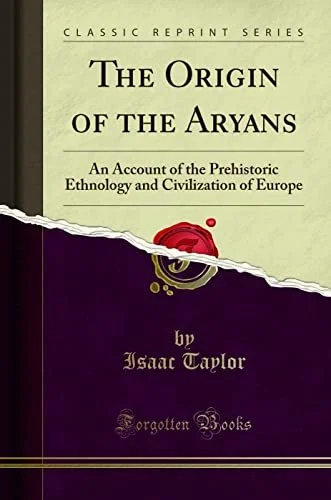
https://archive.org/details/originofaryansac00tayluoft/originofaryansac00tayluoft/
The similarities in four ancient languages provided the first inkling of a prehistoric Aryan nation. In 1786 Welsh scholar Sir William Jones found exceptionally strong similarities in verb structure and grammar among ancient languages—German, Greek, and Sanskrit, in particular, as well as Gothic, Celtic, and Persian. Believing the languages must have sprung from the same source, Jones concluded that the peoples of Armenia, Asia, Europe, and Iran had a common parent. (Isaac Taylor: The Origin of the Aryans)
Following suit, Prof. Max Müller in 1861 concluded not only that the ancient languages came from a single wellspring, he identified the common parental race as the Aryans, butting against the anthropologic evidence of the time that speakers of similar languages did not have a common ancestry. (Taylor)
Müller then located the first Aryans in Asia. He believed there initially was a “small clan of Aryans” who lived in Central Asia and spoke a crude language that had not yet developed into Sanskrit, Greek, or German, then over time spread that language to India and Persia in the south and to Greece, Rome, England, Germany, and Slavonia in the north as they migrated. (Taylor)
Geology, anthropology, and other newly developing sciences soon proved that Asia was not the center of human history, Western Europe was. Cave drawings found along with animal carcasses in caverns along the Dordogne showed that humans had lived at the same time as mammoths in France, far earlier than they had lived in Babylonia or Egypt. Anthropological studies of skulls showed that speakers of Aryan languages belonged to several races and that those races had not lived in Asia but in Europe continuously since the neolithic age. (Taylor)
And Europe, particularly northern Germany, was the only locale where the environment was salutary enough for humans to develop complex language over time. As J. G. Cuno in 1871 argued, it would have required thousands of years for primitive speech to evolve into the complex early languages. Northern Germany had the ideal terrain and climate--undivided and vast plains, few mountain ranges, deserts, or dense forests, and relatively uniform weather conditions—for language to fluorish. (Forschungen im Gebiete der alten Volkerkundence).
The great plain of Northern Europe, stretching from the Ural Mountains over Northern Germany and the north of France to the Atlantic thus became the presumed birthplace of the Aryans, where, Cuno thought, “the conditions of life are not too easy, or the struggle for existence too hard, to make possible the development of a great energetic race such as the Aryans.” (Taylor)
Archaeology and Aryan Prehistory
A principal goal of the Nazi Party was to prove not only that the Aryan race had existed, but it was superior to and dominated other early peoples. Because present-day Germans were directly descended from that race and carried the same blood, they were entitled to take whatever measures were necessary to restore their prehistorical greatness. The Nazi Party sought out and supported historical researchers who could provide this proof, in particular prehistory archeologists who were “deemed … suitable for confirming the supremacist ideology of ‘the Nordic race.’” (Martin Maischberger: German Archaeologoy during the Third Reich, 210).
To do so, prehistorical archaeologists in Germany adhered to five guiding principles or tenets.
The Tenets of Aryan Archaeology
1. Culture Circles. Kulturekreis theory, as promoted by language expert and prehistorian Gustav Kossinna in the 1800s, held that prehistoric Germans had moved across Europe, conquered lesser populations and races, left behind archaeological materials in the territories they had occupied, and those materials now belonged to the German people. As a result, any archaeological site on foreign land “that resembled Nordic heritage” could be usurped. Moving steps further, neighboring countries could be invaded because the land had belonged to Germans originally and was now, therefore, stolen property. (Matt Bouchard: The Use and Abuse of Archaeology to Promote Nazi Nationalist Goals)
2. Social Diffusion. According to this theory, culture and social changes diffused from one group to another as they interacted and shared ideas and materials over time. Particularly important for the Nazi Party was the concept that more advanced peoples diffused or imposed culture and social changes on weaker societies and, in keeping with the Culture Circles theory, “the presence of Nordic ruins on any land made that land Nordic, [and therefore meant it] rightfully belonged to those of Nordic ancestry.” (Bouchard)
Aryan prehistorical archaeology consequently focused on physical evidence of the superiority of the German race, searching specifically for Aryan cultural sites in northern and central Europe to “provide the template for the rebirth of the German race through a return to its origins.” (Bouchard, Puschner)
3. Deutsche Reinheit, or "Pure German Man," theory maintained that the German people were the purest race. Their ancestors had not only survived natural disasters, they had developed the most advanced culture and fostered several small cultural branches outside of Germany. This theory explained why remains of the Aryan culture could be found in other countries, particularly Poland, and why Germany was justified in usurping those archaeological sites and occupying the countries where they were found. (Bouchard)
4. Weltanschauungswissenschaften or "World View Sciences” held that culture, genetics, biology, and race were linked, supporting the notion of Erde and Boden and Blut, Blood and Soil: Germans were connected to the land of their ancestors biologically. These ties were paramount and persisted over time.
Archaeological artifacts in any given location identified the ethnic groups that had lived there as well as their special biological qualities. These special qualities ranked populations hierarchically. At the apex of this ranking were the Aryans whose superiority was passed down to descendants racially and genetically. Efforts to eliminate societal problems, including addiction, criminality, mental illness, and poverty by eliminating lower ranked populations were therefore justified to make sure Germans continued to be the purest race. (Bouchard)
5. Secrecy. The work of prehistorical archaeologists was kept hidden so observers and members of the public, most particularly ordinary Germans, could not judge claims about Nordic heritage for themselves and begin to question the superiority of their Aryan past. Hitler himself worried about divulging too much information about prehistorical archaeology and its findings. He’s quoted as saying, “Why do we call the whole world’s attention to the fact that we have no past? It’s bad enough that the Romans were erecting great buildings when our forefathers were still living in mud huts.” (Bouchard, Bettina Arnold: Past as Propaganda) According to Bouchard, The secrecy code “was so highly protected that it had to be burned during WW II by the Nazy party and today very little remains known about it.”
The next TimeStamp post describes the major Aryan prehistory archaeological organizations, Amt Rosenberg and Ahnernerbe.
Sources:
Bouchard, Matt: The Use and Abuse of Archaeology to Promote Nazi Nationalist Goals, Spectrum: Vol. 1: Iss. 1, Article 2. (2011) Available at: https://scholars.unh.edu/spectrum/vol1/iss1/2
Taylor, Isaac: The Origin of the Aryans. An Account of the Prehistoric Ethnology and Civilization of Europe. By Litt. D., Hon. Ll.D. Illustrated, The Humboldt Publishing Co
Per Cornell, Adam Andersson: The Past, Ethnic Purity, and the Foundations of Nazi Ideology: Archaeology at War, Journal of Archaeological Research, 2025 https://doi.org/10.1007/s10814-024-09205-6
Bettina Arnold: The Past as Propaganda: Totalitarian Archaeology in Nazi Germany. Cambridge University Press, Vol 64, Issue 244, 1990.
Megan Young: The Nazis’ Archaeology, Nebraska Anthropologist, University of Nebraska, 2022.
Martin Maischberger: German archaeology during the Third Reich, 1933-45: a case study based on archival evidence, Antiquity, 209-218, 2002.
Johann Gustav Cuno, Forschungen im Gebiete der alten Vbikerkunde, Berlin, 1871.
Theodor * Posche, Die Arier.
Max Muller, Lectures, 1st Series, pp. 211, 212