The Devil’s Kitchen—Yellowstone National Park
Seasonal National Park Service Ranger Clarence Johnson is introducing a group of hikers to Yellowstone National Park’s Uncle Tom Trail, the 324-stair decline from the top to the bottom of the canyon that replaced the trail established in 1898 by H.F. Richardson and dropped tourists down from the rocky edge using ropes and ladders. After noting a turkey vulture circling above, he opens a laminated copy of artist Thomas Moran’s painting of the Lower Yellowstone Falls, then stops as a girl in the group asks whether the vulture is circling because of the man who’s lying dead below.
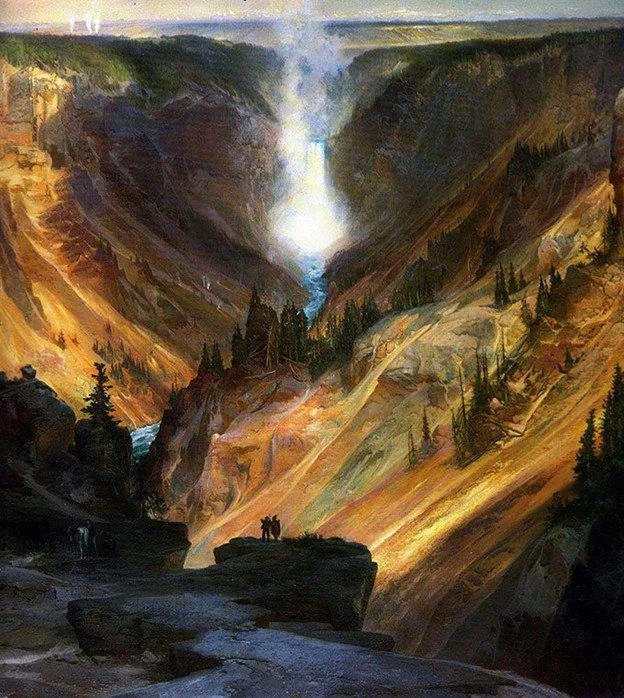
https://www.yellowstonepark.com/things-to-do/natural-wonders/artist-point/
After calling the incident in to the Park Service’s ISB detectives, Clarence meets with Special Agent Alison Nance. Recently retired from the Fort Worth Police Department because of a gun injury to his leg, Clarence explains to Alison that she’s leading the investigation from the wrong crime scene. The dead man was not killed among the piles of rocks where investigators are searching for evidence. The man was killed near the parking area and observation deck where tourists and others are now contaminating forensics.
Impressed by Clarence’s observations and attention to detail, Alison invites him to join the investigation. Their journey is detailed in The Devil’s Kitchen, first in the Johnson and Nance mystery series by author Mark Thielman. The plot moves back and forth between two time periods—the late 1700s and the present day—and two locations—France during the French Revolution and the site of America’s first national park extending from Wyoming to Montana and Idaho.
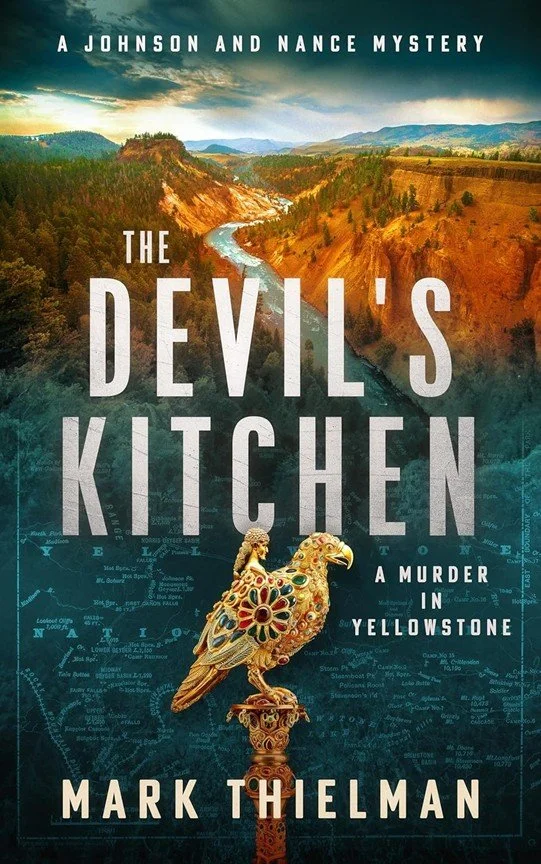
https://markthielman.com/the-devils-kitchen-2/
For this author’s review, see:
The last Time Stamp blog post traveled more than 200 years back in time to explore the object at the heart of The Devil’s Kitchen murder—the 7th Century Scepter of Dagobert and the audacious plot to protect it from revolutionary iconoclasts hell bent on destroying artifacts from France’s feudal past.
This month’s post backpacks along rocky outcroppings to explore today’s Devil’s Kitchen and the Yellowstone National Park and think about their past.
Devil’s Kitchen
The 115- to 128-acre nature preserve in the Bighorn Basin of northern Wyoming, called the Devil’s Kitchen, is a geologic wonder. A classic badland spanning eerie shapes, ravines, rock towers, and steep slopes, the area has layers of sedimentary claystone, sandstone, and shale that surround decorative chalcedony and dinosaur gizzard stones, gastroliths.
Geologists consider the Devil’s Kitchen badlands as “a classic example of inverted topography” or an anticline—a broad, arch-like rock formation created by the action of tectonic forces more than 70 million years ago. “An anticline is folded rock in the shape of an umbrella or an upside down ship hull. At Devils' Kitchen, the top of the umbrella shape is eroded off so it resembles a cut onion.” (https://usa-travelcenter.de/discoveramerica/wbb/wbb2/index.php?thread/17393-devils-kitchen-geological-site-greybull-wy/)
“Think of a rug or a stack of colored paper that is pushed and distorted into wrinkles. In geology each page is a formation or type of rock, like sandstone or mudstone or limestone. Imagine the top page is hard, like a sandstone. Then imagine that the ‘hard’ page overlies a ‘soft page’ composed of mudstone. As the fold was exposed by erosion, the hard sandstone eroded off the top of the fold exposing the soft mudstone below it. At that point, the center of the fold exposed the softest rocks composed of clay-rich mudstones which were susceptible to weathering and erosion. Around the rim today are the most resistant sandstones. The center of the fold now erodes faster than the rim creating a depression in the center of the fold.” (https://www.bighornbasindinos.org/devilskitchen)
A cavern on the badlands is the crater of an extinct hot spring. Adventurers can enter the crater through a six- to eight-foot opening and descend into the Devil’s Kitchen by ladder.
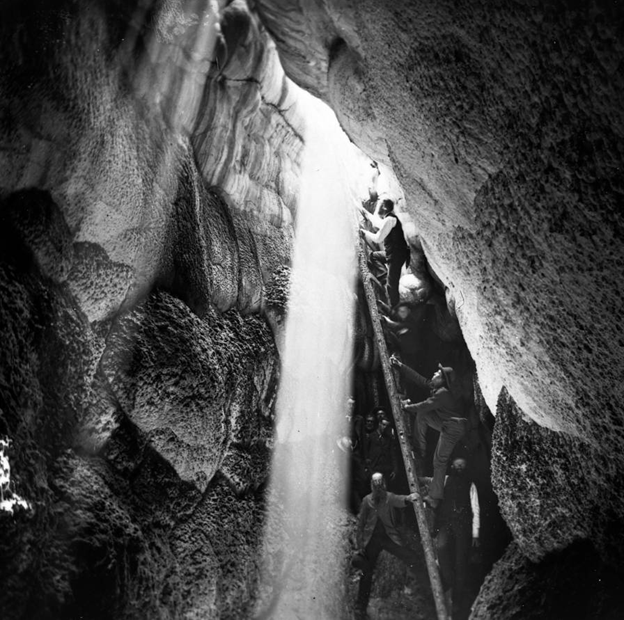
https://yellowstoneinsider.com/2016/05/23/old0yellowstone-history-the-devils-kitchen/
Early Days
The Devil’s Kitchen was first described in 1872, in a report from the June 17 edition of The Avant Courier about discoveries on Mammoth Hot Springs: “The recent discoveries made by Mr. Chas. Millard of Fort Ellis on the property of the proprietors of the springs are the ‘Devil’s Parlor,’ the same gentleman’s ‘Well’ and his Majesty’s ‘Kitchen.’” (https://yellowstoneinsider.com/2016/05/23/old0yellowstone-history-the-devils-kitchen/
(At the time of the Devil’s Kitchen’s audacious plot to smuggle the Scepter of Dagobert out of France and into the American wilderness, Yellowstone had not yet been named as a national park and the Devil’s Kitchen badland was known only to Native Americans. European fur traders may have been active in the area in the late 17 00s, but information is sketchy. American fur traders have been traced to the mid-1800s. https://yellowstone.net/history/the-fur-trade-era-1818-42/)
Yellowstone itself became the world’s first national part only three months before. It wasn’t until 1884 when Devil’s Kitchen itself became a full-blown tourist attraction after a tour operator built a ladder for climbers to descend to its bottom. A. B. Guptill described the experience at that time: “The peculiar damp and heated atmosphere of the interior produces a queer sensation and the desire to seek fresh air at once comes over the visitor. When the Devil’s Kitchen was first explored (in 1881) numerous bones of wild animals were found in the cave and it was alive with the flying bat.” (https://yellowstoneinsider.com/2016/05/23/old0yellowstone-history-the-devils-kitchen/
The Devil’s Kitchen was so popular in the early 1920s that an ice cream and soda pop stand—The Devil’s Kitchenette--was set up nearby. Nevertheless, many visitors, like Edwin James Stanley, considered it to be off limits. In his travelogue Rambles in Wonderland, Stanley explained why he remained on the precipice of the cavern. “Certain portions of the mountain also abound in caverns which were once the scene of boiling reservoirs. One of these has been partly explored, and is known as the ‘Devil’s Kitchen;’ but, meeting at the entrance a volume of the warm, sickening atmosphere, I desisted from further explorations. It was a gloomy, dismal place, and we could see little bats flitting to and fro, after the stones that we dropped in. In one of these caverns I saw the skeleton of a young deer or elk, which, in its playful gambols, had gone too near and fallen in and perished.” (yellowstoneinsider)
Passage down to the floor of the cavern was considered to be safe at the time. But photographer Frank J. Haynes did note a “queer sensation” at the base of the incline, less likely to be due to queasiness about piles of bones and bats flitting overhead than to limited fresh air and an overall feeling of suffocation. The area in fact was closed in 1939 because of dangerous levels of carbon dioxide in the cave. (yellowstoneinsider)
Murder Site
Deaths have occurred on the grounds of Yellowstone National Park, but not in high numbers, and few involving murder. From 2007 to 2023, 74 deaths have been recorded. Most were the result of driving accidents (45 percent); 38 percent happened while hiking, walking, climbing or playing sports. (https://www.becklawyers.com/deaths-in-yellowstone-national-park/
Other national parks are considered to be more dangerous. A survey by Outforia found the Grand Canyon at the top of the list for deaths, with 134. Yosemite was second with 126 deaths, then came the Great Smoky Mountains, 92 deaths, and Yellowstone, with 52 deaths out of a total of 4 million annual visitors. (https://cowboystatedaily.com/2022/03/21/yellowstone-at-150-scaldings-maulings-murders-and-other-unnatural-deaths/
Falls were the most common cause of death in all parks (245), followed by medical and natural causes (192), and undetermined (166). In Yellowstone, the most common cause of death was motor vehicle accidents (12) and heart attacks (12). (cowboystatedaily)
And murders? One in one report of deaths in national parks (https://www.becklawyers.com/deaths-in-yellowstone-national-park/, 8 in another (cowboystatedaily).
Yellowstone National Park is not the only nature preserve to house a Devil’s Kitchen. Lassen Volcanic Park in California also has one. Then there are Devil’s Canyons (in Bighorn Canyon National Recreational Area and North Cascades National Park), Devil’s Dens (one in Yellowstone), a Devil’s Garden, Devil’s Golf Course (in Death Valley), Devil’s Hole (also in Death Valley), and Devil’s Stairway (Yellowstone). There are more than 30 hellish geological configurations in national parks and recreational areas. https://www.nationalparkstraveler.org/2018/11/hell-place-devils-role-national-park-place-names
Sources:
https://www.becklawyers.com/deaths-in-yellowstone-national-park/,
(https://yellowstoneinsider.com/2016/05/23/old0yellowstone-history-the-devils-kitchen/
https://www.bighornbasindinos.org/devilskitchen)
https://markthielman.com/the-devils-kitchen-2/
https://www.geowyo.com/devils-kitchen.html
https://www.yellowstonepark.com/things-to-do/natural-wonders/artist-point/
https://www.yellowstonepark.com/things-to-do/natural-wonders/artist-point/
