Operation Valkyrie
The four necessary elements for an assassination attempt on the life of Adolf Hitler appeared to be in place. In early 1944, conspirators had decided on the method--a bomb; the place—Wolfsschanze; the assassin—Claus von Stauffenberg; and the timing—soon.
But then the Allies invaded.
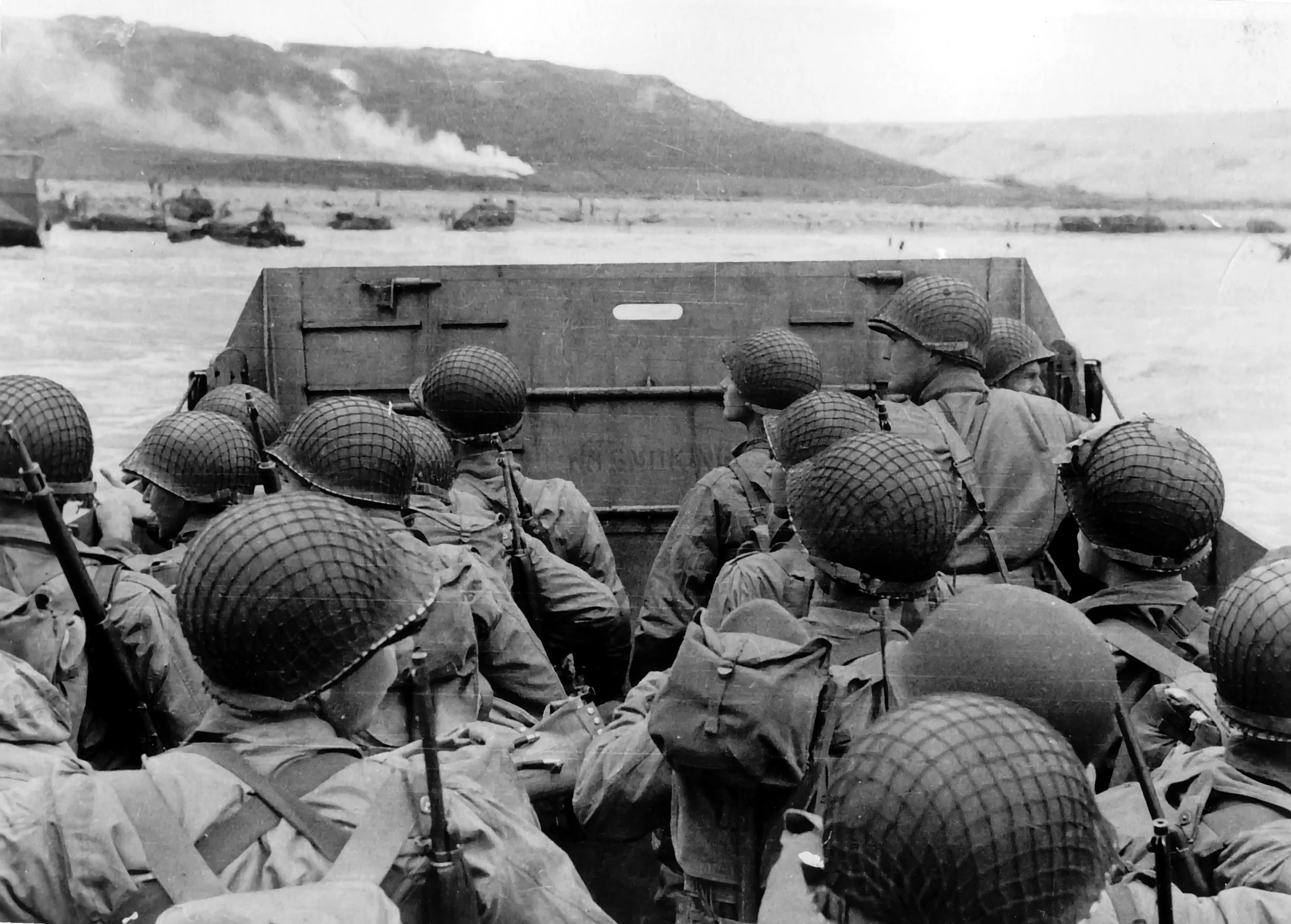
The largest air and amphibious invasion in history mobilized more than 24,000 paratroopers, 150,000 soldiers, and nearly 200,000 naval personnel; sent more than 2000 bombers to attack targets along the Normandy coast as well as 9000 other aircraft; deployed minesweepers, battleships, cruisers, merchant ships, destroyers, and landing craft as well as tanks and teams of engineers and demolition men. The result: D-Day opened up a heavily manned second front against the German Army that almost certainly assured defeat of the Wehrmacht and the dismantling of the Third Reich.
With D-Day came despair among leaders of Operation Valkyrie as their wish that the assassination and military coup would bring a quick end to the war disappeared. “There was now no chance whatsoever that the Allies would agree to a negotiated peace, the war would be fought to the bitter end and millions more lives would be lost.” Their hope to show Allies that they were willing to take the drastic step of removing the leaders of what they considered to be a despotic government—gone. “A putsch against the Nazis—even in the unlikely event of it succeeding—would be a futile gesture at best, since any post-Hitler government would be faced with equally unpalatable options of unconditional surrender or fighting a hopeless war to its inevitable conclusion.” (Nigel Jones: Countdown to Valkyrie, Frontline Books, 2008, p 171.)
But Henning von Tresckow would not be deterred. He was adamant: “The assassination must be attempted, come what may. Even if it fails, we must take action in Berlin [to launch a coup]. For the practical purpose no longer matters; all that counts now is that the German resistance movement must take the plunge before the eyes of the world and of history. Compared to that, nothing else matters.” (Countdown, p. 171)
Run Up to the July 20
Pressures on the conspirators to take action intensified in the days and weeks after D-Day as losses on both the Eastern and Western Fronts mounted.
On June 23, the Soviet Union’s Red Army attacked the German Army Group Centre on four fronts equipped with four times more aircraft and tanks.
Less than a week later, British forces advanced west of Caen, France, and the US Army occupied Cherbourg.
On July 4, the Red Army led a three-fronted assault on German-occupied Baltic States, sources of food and routes of major supply lines between Germany and Finland and Sweden.
The German Army’s Group Centre on the Eastern Front collapsed on July 8, Minsk fell on July 11, and Russian troops were expected to cross the Vistula River, barrel across German territory, and be on the outskirts of Berlin within ten days.
On July 14, Erwin Rommel drafted a letter that warned Adolf Hitler the Allies would soon completely break through German defenses and definitively decide the course of war. Four days later, US forces began to erode and eventually destroy the German 352nd Division at St. Lô, then continued their drive to the east and the steady erosion of German armored divisions. (Eberhard Zeller: The Flame of Freedom, University of Miami Press, 1963, p 295)
In addition to losses on the battlefield, the German Resistance movement was fracturing.
Julius Leber, the former Reichstag deputy and spokesperson for the Socialist Democratic Party, met with other planners of the post-Nazi, coup government on June 21 to discuss whether members of the Communist underground should be included. The next day, he and associate Adolf Reichwein met with two Communist functionaries as well as a mysterious third man who knew and, against underground meeting protocols, addressed Leber by name. At the next scheduled meeting on July 4, Reichwein was arrested; Leber was apprehended the following morning.
Whether the arrests came because the Gestapo had infiltrated the secretive group or because a conspirator in their ranks had betrayed them, leaders of Operation Valkyrie realized they had to act asap.
Early Steps
By early July, Stauffenberg was regularly carrying the briefcase hiding “the whole bag of tricks.” (Countdown, p 176) Though Stauffenberg met with Hitler a number of times, he didn’t pull the pin.
On July 6 and 8, Stauffenberg met with Hitler at the Berghof ironically to fine-tune the original plans for Valkyrie. Since the Allied invasion, the German High Command looked for ways to counteract other attacks, notably against the largely unprotected German coastline to the north. Stauffenberg had been asked to adjust the Valkyrie response to attacks or insurrections at home by planning to move German soldiers home on leave (a total of 300,000 at any given time) into “shell detachments” and give their military commanders emergency executive powers to oversee all government and military operations, including the work of the Nazi Party, Gestapo, and SS, in response. For whatever reason, Stauffenberg did not arm or explode the bomb at either meeting. (Countdown)
On July 11, Stauffenberg again carried the briefcase and bomb to a meeting with Hitler at the Berghof, but again, he did not trigger it because neither Heinrich Himmler nor Hermann Goering had been present. The conspirators had planned to assassinate not only Hitler but also remove the two top leaders of the Nazi regime and assure that neither man could assume control after Hitler’s death. The assassination attempt was not made, therefore. (John Grehan: The Hitler Assassination Attempts, Frontline Books, 2022)
On July 15 at what conspirators considered to be the best location for assassination—Wolfsschanze—Stauffenberg came closer to the assassination than he had before. He and others entered the briefing hut—a one-story wood building with a concrete ceiling, brick supports, and windows with steel shutters—at 1:00 pm. A few minutes after the start of the meeting, Stauffenberg left to make a phone call, allegedly to his chief of staff.
During the call, he acknowledged to Operation Valkyrie leaders that again, Himmler and Goering were absent. This time, though, he received the go-ahead. “Do it,” Oberst Mertz von Quirnheim, chief of the strategic planning arm of the German Army Oberkommando des Heeres (OKH) and coup leader, told him. The attempt nevertheless failed. When Stauffenberg returned to the conference, his briefcase was missing. (Stauffenberg’s associate and supplier of the bomb and its detonator Generalmajor Helmuth Stieff had taken the briefcase while Stauffenberg was out of the room.) By this time, the meeting was winding down. There was not enough time for Stauffenberg to excuse himself and leave again, find a safe place to open the briefcase and set the fuse. (The Hitler Assassination Attempts)
The Debate
By this time, leaders of Operation Valkyrie were torn. They wanted to rid themselves and their country from Hitler and the Nazi regime but wanted Germany to remain a military and political power. To some, Hitler’s assassination had to be accompanied by a coup that established a new government so an Allied victory would not abandon German soldiers, impose rule by invading armies, and perhaps unleash a civil war.
Hitler still had power over the German people and most of the troops on the front lines. By eliminating him and his government, Operation Valkyrie could end up enshrining him as a martyr and blame coup leaders for another “stab in the back” of the country and its people.
“But there were compelling reasons for action…Something had to be done to establish a responsible government which could not be ignored by the Allies. And action had to be taken if the German people were to be given the chance of changing their ways and showing repentance, through their own efforts and not under foreign compulsion.” (Flame of Freedom, p 206)
A friend and associate of Stauffenberg, Rudolf Fahrner, recalled a conversation the two men had on July 4 about whether there was any point to the assassination and coup if the country would soon be occupied. The men agreed Operation Valkyrie could not only save lives and property, it could open the door to a new political life for the German people. “The whole affair was not a matter of outward success. It was a command of moral purification and honour that had to be obeyed.” (Flame of Freedom, p 289)
Stauffenberg and the coup plotters would try one more time—on July 20, 1944.
Sources:
John Grehan: The Hitler Assassination Attempts, Frontline Books, 2022
Nigel Jones: Countdown to Valkyrie, Frontline Books, 2008
Anthony Shaw: World War II, Day by Day, Chartwell Books
Eberhard Zeller: The Flame of Freedom, University of Miami Press, 1963

